

Cummins ($CMI) Deep Dive
From cyclical truck engines to integrated power solutions...

Hi, Investor! 👋🏼
I’m Jimmy, and welcome back to another edition of Jimmy’s Journal.
For most of the last century, Cummins was understood as a cyclical diesel-engine company tethered to the North American Class 8 truck cycle, a business you bought near the bottom and sold near the top.
That framing is now incomplete, and the market is in the awkward middle stage of repricing it.
Underneath the truck cycle, two things have happened:
First, Cummins has assembled the most vertically integrated and most distributed power-and-engine franchise in the world, anchored by an aftermarket and distribution annuity that throws off cash through the cycle.
Second, the AI buildout has turned its sleepiest, lowest-multiple corner, large reciprocating engines for standby power generation, into one of the fastest-growing and highest-margin businesses in industrials.
The result is a company that compounded revenue from $28B in 2022 to about $34B in 2025, lifted adjusted EBITDA margin to a record 17.4% in 2025 while the heavy-truck market was in a downcycle, and just raised its 2030 framework to $45-50B of revenue at a 20% EBITDA margin.
In this deep dive, organized into the sections below, we look at Cummins beyond the usual “truck engine company” label:
Company History
Business Model
Data Centers 101
Products and End Markets
Competitive Advantages
Competitive Landscape
Capital Allocation and M&A
Corporate Governance
Financials and Long-Term Targets
Valuation
Main Risks
Investment Thesis
Final Thoughts
1. Company History:
Cummins was founded in Columbus, Indiana, on February 3, 1919, by Clessie Lyle Cummins - a self-taught mechanic with no formal education beyond the eighth grade - and William Glanton Irwin, the Columbus banker for whom Clessie had worked as a chauffeur and mechanic.
Clessie had built a working steam engine by the age of eleven and had earned a local reputation for mechanical ingenuity. In 1911, he was recruited to the pit crew of a car that went on to win the first Indianapolis 500.
The bet the two men made in 1919 was that Rudolf Diesel’s compression-ignition engine, invented two decades earlier in Germany, could be commercialized for American use, and they began by manufacturing engines under license from the Dutch firm R.M. Hvid.
The early years were brutal…
The first Hvid-derived engines were unreliable, the agricultural market never materialized as hoped, and Irwin grew impatient with the losses.
The founding myth of Cummins, and it happens to be largely true, is that Clessie saved the company through showmanship and proof.
He installed a diesel engine in a used car and drove his skeptical banker around in it; later he drove a diesel-powered car some 800 miles to the New York Auto Show on a little over a dollar of fuel, and entered a diesel vehicle in the Indianapolis 500 that finished without a single pit stop.
The point was always the same: diesel delivered unmatched fuel efficiency and durability, and the market would eventually pay for that.
The commercial breakthrough came in 1933, when the Model H engine found a home in small railroad switchers and proved itself in the field.
The company’s modern character was shaped less by Clessie than by J. Irwin Miller, William Irwin’s great-nephew, who took the helm and led Cummins to international prominence over four decades.
Miller is one of the more remarkable figures in American corporate history, a CEO who paired relentless engineering and quality discipline with an almost unheard-of commitment to civic life, architecture, and ethics in Columbus, Indiana.
The culture he built, conservative on quality, long-term in orientation, allergic to short-cuts, is still recognizable in the company today, and it is part of why the 2024 emissions settlement (more on that below) landed as such a reputational shock.
Through the postwar decades Cummins became the dominant independent supplier of heavy-duty diesel engines to North American truck makers, a position it holds to this day.
A defining feature of its history is its relationship with the OEMs that buy its engines.
Truck manufacturers can, in principle, vertically integrate and build their own engines, and several do; the persistent question for Cummins has always been whether its OEM customers will continue to outsource.
Ford held roughly a 10.8% equity stake in Cummins from 1990 to 1997 before Cummins repurchased the shares, and to this day Cummins powers the heavy-duty RAM pickup line under a long-standing supply agreement with Stellantis, a commercial relationship frequently and incorrectly mistaken for ownership.
Three corporate events in the most recent chapter matter for the current thesis:
First, in 2022 Cummins acquired Meritor for $3.7B, adding axles, brakes, and drivetrain systems to its Components segment and deepening its content per vehicle.
For Columbus residents the deal carried a local resonance, since Meritor’s lineage traced back to Arvin Industries, founded in the same town the same year as Cummins.
Strategically, the logic was content expansion: as powertrains evolve, owning more of the driveline lets Cummins capture more dollars per truck regardless of fuel type.
Second, in 2023 Cummins carved out its filtration business as Atmus Filtration Technologies via an IPO, and completed the full separation in 2024.
Filtration was a good business but a slower-growing, lower-multiple one, and the separation sharpened the remaining company around engines, power, components, distribution, and the energy transition.
Third, and most painfully, in January 2024 Cummins finalized a settlement with the US Department of Justice, the EPA, the California Air Resources Board, and the California Attorney General over emissions violations in RAM pickup engines.
Cummins agreed to a $1.675B civil penalty, the largest ever under the Clean Air Act and the second-largest environmental penalty in US history, plus more than $325M in mitigation and recall costs, bringing the total to roughly $2B.
The case involved software “defeat devices” in model-year 2013 to 2023 RAM 2500 and 3500 diesels, with a recall covering more than 600,000 vehicles.
For a company whose entire brand equity rests on engineering integrity and regulatory credibility, this was a genuine black eye, and it is a permanent entry in any honest bear case: the company that markets itself as the trusted, compliant powertrain partner was found to have circumvented the rules at scale.
Found this content valuable? Share it with your network! Help others discover these insights by sharing the newsletter. Your support makes all the difference!
2. Business Model:
Engine:
The historical core. It designs and builds diesel and natural-gas engines from 2.8 to 15 liters and 48 to 715 horsepower for trucks, buses, light-duty pickups, and off-highway equipment.
In FY2025 this segment ran at roughly $10.9B of revenue, split across:
Heavy-duty truck: 32%
Medium-duty truck and bus: 33%
Light-duty automotive: 18%
Off-highway: 17%
It is the most cyclical and lowest-margin of the major segments, and in the Q1 2026 it carried an adjusted EBITDA margin of just 10.4% as North American truck demand softened.
Components:
Built up substantially through the Meritor acquisition, this segment supplies aftertreatment and emissions systems, turbochargers, axles, brakes, drivetrain, and automated transmissions for commercial vehicles.
FY2025 revenue reached $10.1B, primarily driven by:
Drivetrain & Braking Systems: 40%
Emissions Solutions: 34%
Components & Software: 22%
Automated Transmissions: 4%
Cummins is the largest turbocharger supplier in the world for commercial applications. Components matters enormously for the EPA 2027 thesis, because tighter emissions rules mean more aftertreatment content per truck.
Distribution:
Distribution wholesales engines, gensets, and service parts, and performs service and repair on Cummins products, through a global network.
With FY2025 revenue of $12.4B, Distribution is the company's largest segment.
The network spans more than 640 distributor locations and over 13,000 certified dealers worldwide. Revenue is diversified across Power Generation (40%), Parts (33%), Service (14%), and Engines (13%).
This is the aftermarket annuity: a growing installed base pulls parts and service through the cycle, and importantly, roughly half of Cummins' data-center revenue is captured here through installation, service, and aftermarket, not only in Power Systems.
Power Systems:
The crown jewel of the moment. An integrated power provider designing and selling standby and prime power gensets, large industrial engines of 16 liters and above for mining, oil and gas, marine, rail and defense, alternators, and power components.
FY2025 revenue reached approximately $7.5B, driven primarily by Power Generation, which accounted for nearly 60% of sales. Parts contributed 17%, while Industrial Solutions and Generator Technologies represented 15% and 8%, respectively.
This is where the AI data-center demand lands first and hardest, and the margins reflect it: in Q1 2026, Power Systems posted an adjusted EBITDA margin of 29.5%, up from 23.6% a year earlier, on revenue up +19% y/y.
Accelera:
The zero-emissions bet, formerly known as the New Power business.
Accelera develops battery systems, fuel-cell engines, electric powertrain solutions, and hydrogen production technologies - and it is also where the zero-emissions assets from the Meritor acquisition landed.
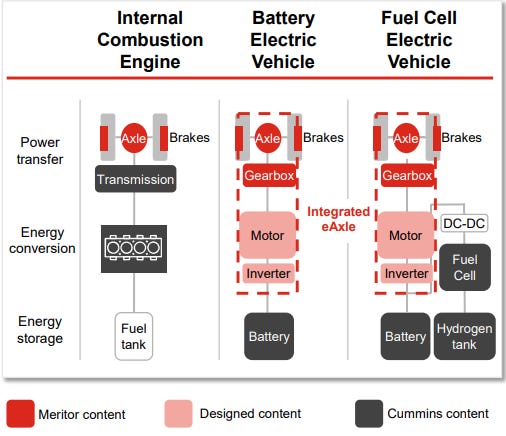
The eAxle platform, which integrates motor, inverter, and gearbox into a single unit for battery-electric commercial vehicles, sits here alongside Cummins’ own fuel cell and electrolyzer programs.
The Meritor deal extended Cummins’ content map beyond diesel, giving the company a credible position across all three powertrain architectures - ICE, BEV, and FCEV.
In practice, the segment remains small and structurally loss-making. Accelera generates roughly $400M in annual revenue - less than 4% of group sales - and has yet to reach profitability.
It has been the source of most of the company’s recent disappointment, and we will address that in detail later in this report.
Intersegment Integration:
The genius of the structure is the intersegment integration.
The Engine segment sells engines into Power Systems for gensets and into Distribution for resale.
Components sells aftertreatment and turbos into Engine.
Distribution sells the parts and service for everything.
A single data-center genset order can touch Engine (the base engine), Power Systems (integration into the genset), and Distribution (installation, commissioning, and a multi-decade service tail).
This is why Cummins reports large intersegment eliminations ($1.98B in Q1 2026) and why looking at any single segment in isolation understates the franchise.
The company captures margin at multiple points along the same physical product, and it captures the highest-margin, most-recurring slice, parts and service, for decades after the initial sale.
The economic engine underneath all of this is the installed base:
Cummins highlighted more than 2.2M active on-highway engines in North America alone, with parts intensity peaking around years 7-11 of an engine’s life and extending well beyond, including roughly $250M of parts sold in 2025 for engines and components built before the year 2000.
An engine sold today is not a one-time transaction, but a opening payment on a 15- to 25-year stream of high-margin parts and service.
This is the annuity that makes Cummins far less cyclical at the cash-flow level than the truck-build chart would suggest.
Found this content valuable? Share it with your network! Help others discover these insights by sharing the newsletter. Your support makes all the difference!
3. Data Centers 101:
Data centers are, without a doubt, the most important value-creation opportunity for Cummins today - and the primary reason behind the company’s recent re-rating from approximately 15x to 21x P/E.
With that in mind, I decided to go back to the basics and explain why Cummins plays such a critical role in the AI infrastructure buildout, so everyone can start from the same foundation.
The three archetypes:
Retail facilities are the smallest of the three, typically drawing a few megawatts of power and usually sitting inside or near cities. They host a large number of small tenants who each lease a handful of racks or a few kWs, and their value proposition is dense, low-latency interconnection that lets customers cut their networking costs.
Wholesale facilities are a step up in scale, generally in the ten to thirty megawatt range, and they lease in much larger blocks, an entire row or several rows at a time, often with contractual options to expand.
A defining characteristic is phased construction: wholesale operators frequently build out in stages so their capacity grows alongside a customer’s rising demand rather than sitting idle waiting for it.
Hyperscale is where the money and the megawatts concentrate. These are frequently self-built campuses operated by the largest technology firms, the Microsofts, Googles, Amazons and Metas of the world, with individual buildings drawing somewhere between 40-100MWs and full campuses reaching into the hundreds of megawatts. Some of Google’s sites are reported above 300MW on their own.
Big Tech does not always build everything itself; it also hires colocation providers to construct “build-to-suit” (BTS) facilities engineered to its exact specifications and then leases them back. Single leases now routinely exceed hundreds of megawatts.
The Tier system:
A data center’s entire reason to exist is uptime.
The industry codifies this into four Tiers, ranked by reliability and by the redundancy built in to protect against any interruption to the power supply.
The standard way the industry measures reliability is permitted downtime per year, and the Tiers sort cleanly along that axis.

Data center operators typically describe reliability using terms like N, N+1, or 2N.
The concept is actually quite simple:
If a facility needs ten generators to operate at full capacity, then N equals ten.
An N+1 design means installing an extra unit as backup, so eleven generators instead of ten.
A 2N design goes a step further, essentially building two complete systems. In that case, the facility would install twenty generators even though only ten are needed to run the workload.
Most large hyperscale data centers today are built to Tier 3 standards, which require the facility to remain operational even when equipment is taken offline for maintenance.
That usually translates into extra generators, transformers, and other backup systems throughout the site.
Some mission-critical facilities go even further with Tier 4 designs, where the infrastructure is built to tolerate unexpected failures without interruption.
Reliability requirements turn power demand into equipment demand at a multiple.
A data center that requires 100 MW of backup generation does not necessarily purchase 100 MW of generators. Under an N+1 architecture, it buys more than that. Under a 2N architecture, it may purchase roughly twice as much capacity as it strictly needs to operate.
In other words, the industry is not simply buying power. It is buying power plus redundancy.
In other words, the AI-focused hyperscale campuses being built by companies like Amazon, Meta, Microsoft, and Google also tends to require the highest levels of availability. As a result, every megawatt of computing demand translates into more than a megawatt of equipment demand.
So when forecasts call for data center power consumption to increase dramatically over the next decade, the opportunity for suppliers like Cummins is even larger than it appears at first glance.
The data center electrical flow:
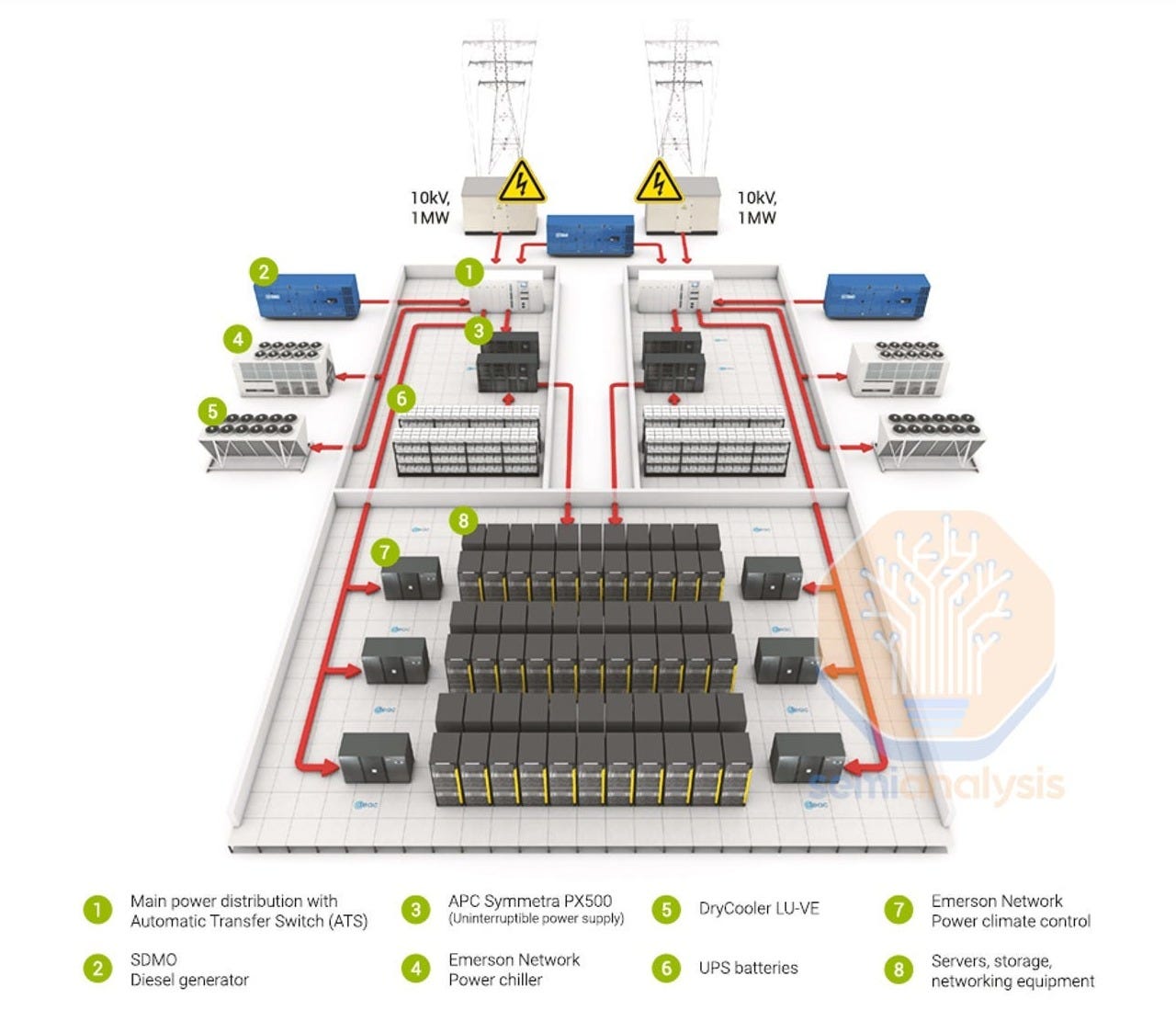
Utility grid to switchgear: for most data centers the electrical grid is the primary source of power, drawing on everything from coal and natural gas to nuclear and renewables. When that power arrives, it hits the switchgear, the first point of contact, which distributes power to smaller circuits and controls current flow so individual circuits and equipment can be isolated for maintenance.
Switchgear to UPS: from there power moves through transformers that step voltage to usable levels and on to the UPS systems, which regulate power to the load and smooth out both losses and surges so the IT equipment receives a constant, clean feed. Critically, the UPS is typically backed by a battery energy storage system (BESS) that provides enough ride-through time, sized to the facility, to let the backup generators start.
UPS to PDU: power then flows to the power distribution units, which provide large-scale standard outlets and maintain adequate power across the IT infrastructure. More advanced PDUs, common in Tier 3 and Tier 4 sites, also monitor consumption, and that monitoring feeds the key efficiency metric we will return to in a moment.
PDU to the rack: finally a remote power panel (RPP) carries power from the PDU to the server racks themselves, with redundant feeds and remote monitoring.
So... where does the generator come in?
The Cummins genset does not sit in the everyday flow at all.
It sits in parallel, waiting.
The moment the utility feed drops, the UPS and its BESS instantly carry the entire facility on stored energy.
That ride-through buys seconds to a couple of minutes, which is precisely the window the diesel or gas genset needs to start, come up to speed, synchronize, and assume the full load until grid power returns.
There are still two important factors to consider:
First, the genset has to be sized to the entire facility load, not just the IT load. As we are about to see, IT equipment is only about a third of a data center’s power draw, so the generator that backs it up is sized against cooling, distribution losses and everything else as well.
Second, the backup system must be sized to absorb transient spikes, including the surge when a depleted UPS battery begins recharging, which can momentarily reach around twenty percent of the rated UPS load.
Both facts push genset sizing up, and bigger gensets are exactly where Cummins has been adding capacity.
Where the power actually goes?
Contrary to what many investors assume, the largest consumer of energy inside a data center is not the servers, storage systems, or networking equipment.
It’s cooling.
A widely used benchmark from Schneider Electric, based on a roughly 5,000-square-foot data center with a 50kW critical load, illustrates this surprisingly well:
Cooling (50%): in a typical data center, cooling can consume more power than the servers themselves. The exact number depends on the system.
Chilled water is usually more efficient, consuming around 70% of the peak load it supports.
Direct expansion systems, which are closer to traditional air-conditioning units, can consume almost 100% of the load they support. So for a 1,000 kW IT load, cooling alone could require 700-1,000 kW.
Critical IT load (36%): this includes servers, storage, networking, and the monitoring, fire, and security systems around them. And this load keeps moving higher. Data centers typically refresh their IT equipment every few years, replacing older hardware with denser, more power-hungry systems. That is one reason power demand can rise even without adding much physical space.
UPS losses and battery charging (11%): UPS systems are not perfectly efficient. Even at around 90% efficiency, the energy lost is still a real power draw. Battery charging is usually small, but after a discharge it can briefly spike to a much higher level, which means the generator and service entrance still need to be sized for that possibility.
Lighting (3%): small, but not zero. It scales mostly with floor area, at roughly two watts per square foot.
Power Usage Effectiveness (PUE):
Power Usage Effectiveness (PUE) is the ratio of total facility energy to the energy used by the IT equipment alone.
A PUE of 1.0 is the theoretical ideal, meaning every watt goes to computing and nothing to cooling or overhead, so lower is better.
Average PUE was around 2.20 in 2010 and had fallen to roughly 1.55 by 2022. Hyperscalers, with their engineering resources, generally run below 1.4, while retail and wholesale sites sit above.
Since cooling alone can represent roughly half of a data center’s power load, and IT refreshes keep pushing rack density higher, the backup power required to support the facility grows with the entire site, not just the compute layer.
That is the key point…
The AI buildout is increasing both rack-level density and total facility power draw at the same time. For Cummins, that means the addressable generator opportunity per site is expanding from two directions at once: more compute to back up, and more supporting infrastructure required to keep that compute running.
BESS, Microgrids (MMCs), and the TAM expansion:
For decades the backup generator was a low-utilization insurance policy.
It ran a few hours a year for testing and almost never for real.
The most important structural change in this market, and the one that genuinely re-rates the Cummins opportunity, is the move beyond pure standby into bridge power, prime power and full microgrids.
Three product layers enable it:
Battery Energy Storage Systems (BESS): a BESS stores excess power from any source, diesel, natural gas, wind, solar, biogas or hydrogen blends, to provide reliable short-term backup and to anchor a microgrid.
It is the ride-through layer that holds the load while a generator starts, but it does more than that…
Stored energy can be dispatched into grid service markets to avoid costs or earn compensation, turning a cost center into an asset that can generate return.
This is where Caterpillar competes directly with Cummins, particularly through its Energy Time Shift, Energy Capacity Expansion, and Power Grid Stabilization product lines, with output ratings ranging from roughly 0.57 MW to 1.26 MW.
Microgrid Master Controllers (MMC): the MMC is “the brain”. It is the central command system that orchestrates every energy source, traditional and renewable, into one coordinated system, working alongside the switchgear to connect loads in the most cost-effective way.
It provides a single interface for monitoring and control, optimizes assets to lower energy cost, and manages import and export with the local utility.
Caterpillar sells two controllers, the MMC-S for smaller installations and the MMC-M for medium-to-large industrial sites, and pairs them with scalable solar modules.
Cummins offers a comparable pair, the MGC 300 for simpler, smaller-scale, cost-sensitive applications, and the MGC 900 for larger, more demanding sites that need advanced control, optimization and reliability features.
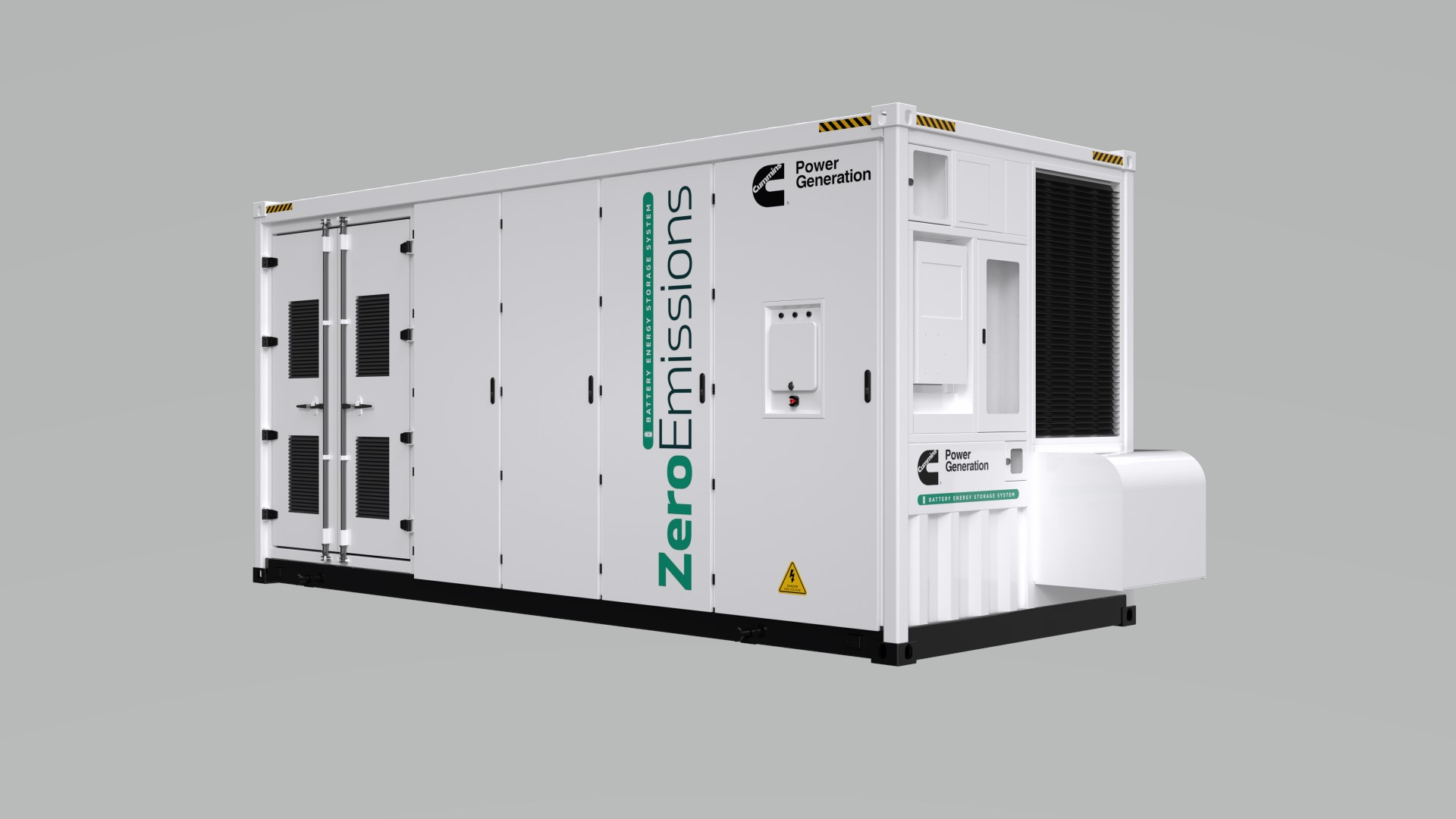
Prime Power: the single biggest TAM-expanding move arrived at the May 2026 Analyst Day, where Cummins outlined a new 4 MW natural gas engine aimed squarely at data center prime power.
The logic is the grid itself: interconnection queues in major markets now stretch for years, and hyperscalers cannot wait for utility capacity that does not yet exist.
The answer is to generate on site and run continuously, “prime” or “bridge” power, until the grid catches up. This changes the unit economics entirely. A standby genset runs a handful of hours a year.
A prime power engine runs thousands of hours a year, which multiplies both the value of the equipment and, crucially, the aftermarket parts and service stream that follows it.
A backup engine that almost never runs sells very few replacement parts. An engine running continuously is an annuity. That is the bridge between Cummins’s Power Systems and Distribution segments, and we will return to it as well.
Already a Pro subscriber? Feel free to skip this section and jump straight to the full report below.
This article is exclusively available to paid subscribers of Jimmy’s Journal.
Inside the full report, we break down:
How Power Systems, Distribution, data centers, backup power, and prime power could reshape Cummins’ earnings base
What the company’s key products are, how they create value for each customer segment, and how Cummins differentiates itself from its main competitors
How valuation, price target, and the investment thesis evolve as the business mix improves
↳ Upgrade to Jimmy’s Journal Pro using the link below to unlock the full investment thesis: