


Hi, Investor 👋
I’m Jimmy, and welcome to another edition of Jimmy’s Journal.
Warren Buffett famously said:
“The single most important decision in evaluating a business is pricing power. If you’ve got the power to raise prices without losing business to a competitor, you’ve got a very good business. And if you have to have a prayer session before raising the price by a tenth of a cent, then you’ve got a terrible business.”
Most investors agree with Buffett in theory.
Few know how to spot pricing power in the data.
That’s because pricing power is often confused with something far more superficial: price increases.
In reality, many companies raise prices every year - and still destroy value.
True pricing power is rare. And when present, it leaves very specific fingerprints.

Welcome to Jimmy’s Journal - your one-stop shop for becoming a better investor.
Written by a former equity analyst, for investors who seek high-quality businesses.
Subscribe now and start compounding.
In case you missed it, here are some recent insights:
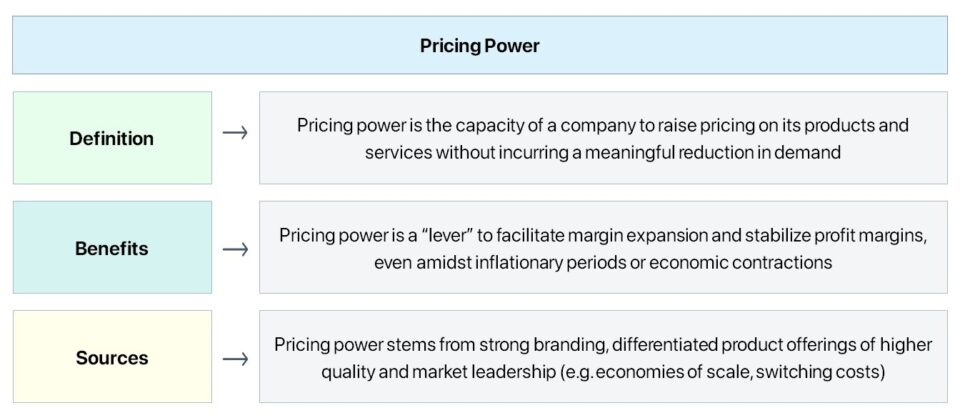
What is Pricing Power?
Pricing power is the ability to increase prices without materially changing customer behavior and without impairing long-term economics.
Not temporarily. Not due to inflation.
Neither because of supply bottlenecks.
A company with pricing power can:
Sustain revenue when demand weakens
Protect margins through cycles
Preserve ROIC despite higher prices
In short, pricing power is revealed when conditions turn unfavorable.
Found this content valuable? Share it with your network! Help others discover these insights by sharing the newsletter. Your support makes all the difference!
Supply, Demand and Inelasticity:
From an economic perspective, pricing power exists where demand is inelastic.
In elastic markets, small price increases lead to sharp volume declines. Customers are price-sensitive and alternatives are abundant.
In inelastic markets, customers absorb price increases with minimal change in consumption. The product is either:
essential,
differentiated; or
deeply embedded in workflows.
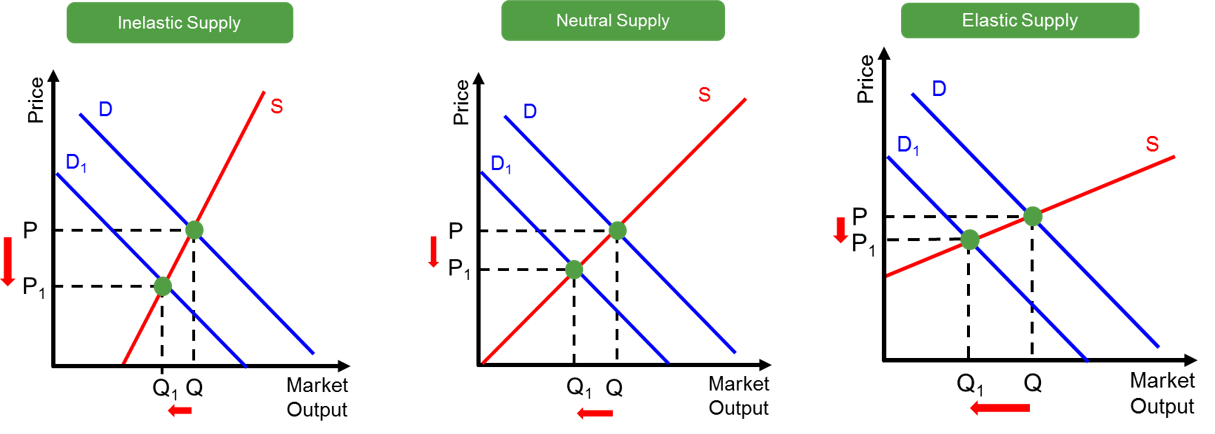
Commodity businesses sit at the wrong end of the spectrum. When demand softens slightly, prices collapse along the cost curve. Margins vanish. Capital is destroyed.
Between 2013 and 2015, a modest slowdown in iron ore demand caused prices to fall by roughly two-thirds. Revenues collapsed, EBIT halved, leverage spiked - even for diversified miners.
That’s what no pricing power looks like.
Enjoying the content? Don’t miss out on more exclusive insights and analyses. Subscribe now and stay updated.
The Sources of Pricing Power:
Pricing power is not accidental - and it is never generic.
The sources of pricing power are industry-specific, shaped by:
customer behavior
competitive structure
substitution risk
regulation
and the economic cost of switching
At a high level, pricing power emerges when a company controls a constraint - legal, behavioral, operational, or economic - that prevents customers from easily re-optimizing their choices.
Below, we break down the core structural sources of pricing power, how they actually work, and how they manifest in financial outcomes.
1. Brand:
Brand-driven pricing power exists when customers stop re-optimizing decisions based on price. Strong brands reduce price sensitivity by anchoring choice in trust, identity, and habit - not in promotions or discounts.
This creates behavioral inelasticity. Small price increases do not trigger substitution because customers perceive alternatives as inferior, riskier or simply “not the same.”
A strong brand typically results in:
stable volumes despite price increases
limited promotional activity
pricing that runs quietly ahead of inflation
Importantly, brand is not marketing spend. It is accumulated trust. And like trust, it requires constant reinforcement. Without disciplined investment and stewardship, brand-based pricing power decays faster than most investors expect.
E.g.: Hermès ($RMS.PA), Apple ($AAPL) and American Express ($AXP).
2. Product Differentiation:
Product differentiation creates pricing power when the value gap versus alternatives is both real and defensible.
This is most evident in highly technical or complex products, where performance differences matter and cannot be closed through incremental improvements.
Differentiation at this level is rarely accidental - it is the result of years (or decades) of sustained R&D and capital investment.
When differentiation is genuine:
customers optimize for outcomes, not price
switching becomes risky or economically irrational
demand becomes structurally less elastic
E.g.: Netflix ($NFLX), TSMC ($TSM) and ASML ($ASML).
3. Switching Costs:
Switching costs are among the most durable sources of pricing power, especially in B2B and enterprise markets.
They emerge when changing suppliers requires customers to absorb real friction: retraining, data migration, workflow disruption, compliance risk or productivity loss. In these cases, price becomes a secondary variable.
Switching-cost pricing power usually shows up through:
low churn
high net revenue retention
muted customer reaction to price increases.
E.g.: Microsoft ($MSFT), Adobe ($ADBE) and SAP ($SAP).
4. Limited Market Competition:
Pricing power strengthens materially when close substitutes are scarce.
This does not require monopoly power. It requires low functional substitutability. When alternatives are meaningfully inferior - whether due to quality, trust, regulation, or acceptance - customers tolerate price increases with minimal behavioral change.
In these environments, prices are set less by marginal cost and more by value delivered. The key risk is not new entrants, but structural changes that reduce the uniqueness of the offering and restore substitutability.
E.g.: Moody’s ($MCO), S&P Global ($SPGI) and Visa ($V).
5. Economies of Scale:
Scale creates pricing power only when it produces a structural cost advantage.
When higher volume leads to meaningfully lower unit costs, incumbents gain pricing flexibility while new entrants face inferior economics. In this setup, pricing power is defensive rather than extractive.
Scale-based pricing power allows companies to:
remain profitable at prices competitors cannot sustain
deter entry without sacrificing returns
protect margins during downturns
Eg: I could point to Walmart ($WALM) or The Home Depot ($HD) as strong examples, but the clearest and most powerful one is OPEC.
By controlling the largest reserves with the lowest extraction costs, OPEC can increase production to push prices down and force marginal producers out of the market - including US shale.
6. Regulation, Patents and Trust-Based Barriers:
In some industries, pricing power is reinforced by legal and institutional constraints.
Regulation, patents and licensing requirements limit competition by raising entry costs and reducing the number of viable players. However, regulation alone is not enough. What sustains pricing power is trust.
When customers rely on a product or service for safety, compliance, or critical outcomes, substitution becomes extremely difficult. Demand turns structurally inelastic.
Regulation limits entry. Trust sustains pricing power.
E.g.: Eli Lilly ($LLY), MSCI ($MSCI) and CME Group ($CME).
Found this content valuable? Share it with your network! Help others discover these insights by sharing the newsletter. Your support makes all the difference!
How to Identify Pricing Power?
Pricing power is not an abstract concept. It can be observed - if you know where to look.
While pricing power can be assessed through a mix of quantitative and qualitative signals, there are two primary leading indicators that consistently point to its presence:
Gross margin (level and quality):
Gross margin is the most direct quantitative proxy for pricing power.
Companies with real pricing power tend to operate with structurally higher margins than peers, reflecting favorable unit economics rather than temporary conditions. Gross margin, contribution margin, and operating margin usually stand out because pricing is driven by value delivered, not by cost competition.
That said, margin level alone is not enough. What truly matters is whether margins are supported by economic strength - not accounting optics.
Margin stability across cycles:
Pricing power reveals itself most clearly under stress.
Companies with genuine pricing power are able to maintain - and sometimes even expand - margins during downturns, cost shocks, or inflationary periods. Rather than absorbing higher costs, they pass them through with limited impact on customer behavior.
Anyone can look strong at peak demand. Only pricing power survives adverse conditions. This is why margin stability over time is often a more reliable signal than margin height at a single point in the cycle.
Can we look beyond margins?
Margins are the clearest signal of pricing power - but they’re a lagging one.
Early indicators live in customer behavior:
Churn (especially after price increases):
One of the cleanest real-world tests of pricing power is customer behavior following repricing.
The key question is not whether prices went up - but whether customers stayed.
If churn remains stable after price increases, and downgrades are limited, demand is likely inelastic. If churn spikes, pricing power was probably overstated.
Net Revenue Retention (NRR):
NRR captures pricing power in motion.
Sustained NRR above 100% indicates that price increases, expansion, and upselling more than offset customer losses. It suggests customers are not only tolerating higher prices, but deepening their relationship with the product (share of wallet).
In many subscription businesses, NRR is a stronger signal of pricing power than gross margin.
Price x Volume x Mix Decomposition:
Revenue growth should always be decomposed into its drivers.
Pricing power exists when price contributes meaningfully to growth without destroying volume. If revenue is rising solely because of price while units are collapsing, the signal is weak.
True pricing power allows companies to reprice while keeping volumes stable - or to improve mix without forcing customers away.
Negotiation Behavior (discount discipline):
Companies with genuine pricing power tend to exhibit pricing discipline at the point of sale. They grant fewer exceptions, rely less on bespoke discounts, and maintain shorter, more predictable sales cycles.
In other words, customers negotiate less - and accept more.
This matters because pricing power is not just about list prices, but about realized prices. A company that constantly gives concessions is revealing elasticity, even if headline prices appear to be rising.
Enjoying the content? Don’t miss out on more exclusive insights and analyses. Subscribe now and stay updated.
The Trap: False Signals of Pricing Power
One of the biggest mistakes investors make is confusing temporary pricing effects with durable pricing power.
Some of the most common traps include:
Supply shortages: temporary scarcity can create the illusion of pricing power. But once supply normalizes, prices often revert, margins compress, and excess returns disappear. True pricing power persists even when capacity returns.
Accounting optics: rising revenue per customer can mask volume erosion, rising churn, or heavier discounting. Pricing power is about realized prices and behavior, not headline metrics.
One-off price resets: companies that rely on sporadic “catch-up pricing” often lack confidence in demand elasticity. Pricing power usually shows up through regular, predictable pricing cadence - not emergency adjustments.
It’s also important to analyze each company’s cost control. If selling prices rise but production costs increase even faster, margins get compressed. In that scenario, pricing power is insufficient to preserve the business’s unit economics.
Found this content valuable? Share it with your network! Help others discover these insights by sharing the newsletter. Your support makes all the difference!
Pricing Power Framework:
Over the years, I’ve tried to organize these ideas into a framework of my own.
A simple matrix that helps separate businesses with true pricing power from efficiency-driven players - and from those that are merely surviving.

True compounders:
These businesses can raise prices and prevent costs from outrunning revenue.
As a result, unit economics improve over time and margins expand structurally.
E.g.: Apple, Netflix and American Express.
Pricing power with cost pressure:
These companies can raise prices, but input cost volatility (commodities, labor, logistics, FX) limits margin expansion. Pricing power exists, but it is partially offset by an unfavorable cost structure.
Margins tend to be volatile rather than structurally compounding.
E.g.: Nike, P&G and Nestlé.
Efficiency players:
These businesses lack meaningful pricing power but survive through tight cost discipline, scale, and operational efficiency.
Margins are thin but stable, and competition is primarily on execution and volume rather than differentiation. They tend to be resilient operators.
Eg.: Costco, The Home Depot and Walmart.
Value destroyers:
These businesses lack the ability to raise prices and struggle to control costs. Margins get squeezed from both sides, especially during downturns.
These models are highly cyclical and structurally fragile.
E.g.: Airlines and low-end commodity producers.
As a rule of thumb, you want to be on the left side of the matrix - ideally in the upper quadrant.
Enjoying the content? Don’t miss out on more exclusive insights and analyses. Subscribe now and stay updated.
Real-World Examples:
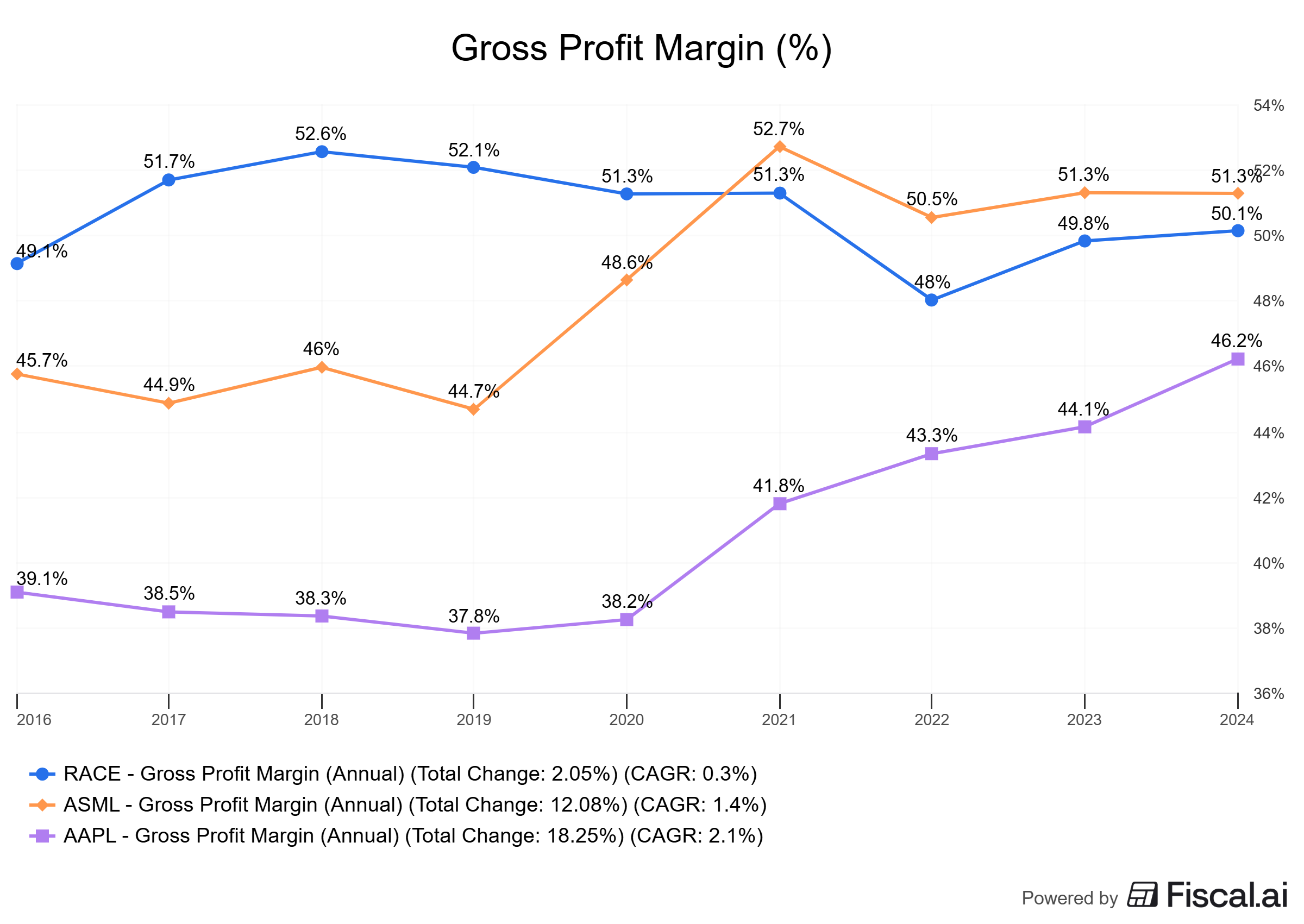
Pricing power becomes visible when margins don’t just stay high, but remain resilient over time.
The chart below shows how companies with different competitive structures convert pricing decisions into sustained gross profitability:
Final Thoughts:
Pricing power sits at the center of long-term compounding.
It stabilizes margins.
Protects ROIC.
Enables reinvestment at attractive returns.
And most importantly, it allows businesses to survive - and even strengthen - when conditions turn unfavorable.
Markets tend to obsess over valuation multiples and short-term growth rates. Great investors focus on something far more durable: economic power.
Over time, it is pricing power - not narratives, not temporary growth spurts - that separates businesses that merely grow from those that truly compound.
Jimmy’s Journal Premium is built around this exact framework.
We study businesses that can raise prices without losing customers, protect returns on capital, and compound value over long horizons - regardless of the macro environment.
Since 2023, our real-money portfolio has compounded capital at a 39.8% CAGR, versus 21.3% for the S&P 500, by consistently investing in these high-quality businesses.
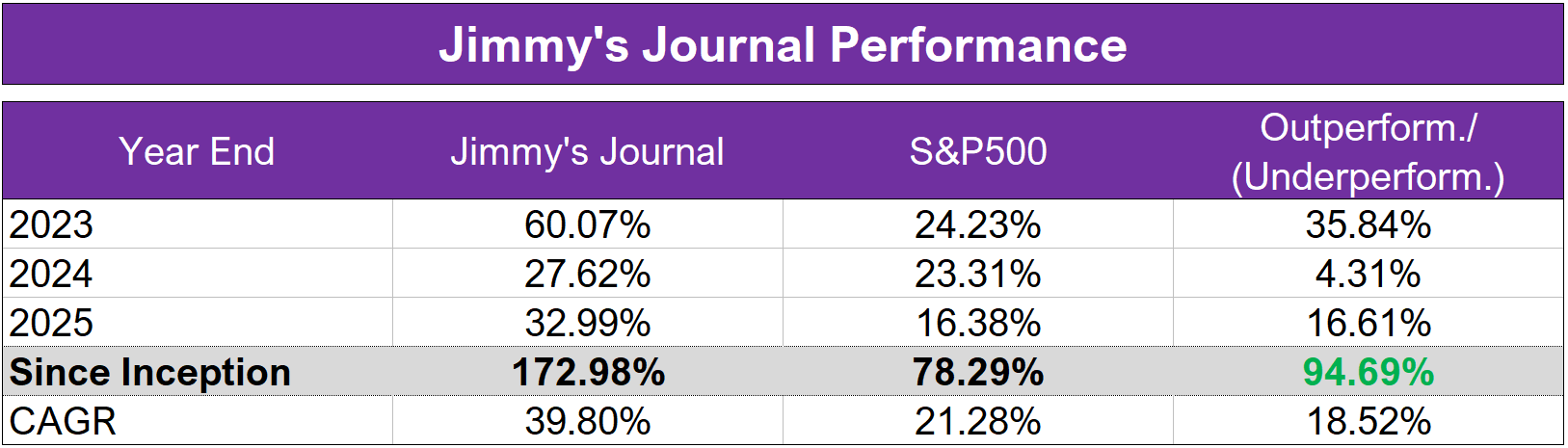
For just $129.99 per year, you gain access to our long-term portfolio of compounders, along with in-depth research and practical insights designed to help you become a better investor.
↳ Become a Premium subscriber now and start building long-term wealth - not for speculators.
If you enjoyed this article, please share it with a friend who might find it useful.
Thanks for sticking with me until the end. See you in the next one.
Cheers
Jimmy
Disclaimer
As a reader of Jimmy’s Journal, you agree with our disclaimer. You can read the full disclaimer here.
By subscribing could your portfolio be copied or would I have to analyze investments?
To give customers more value than competitors, you either need to provide an offering that is either better or cheaper. If you are able to do so in a way no one can replicate, then you got something special. As such, depending on the business, I observe oftentimes you need to sacrifice margins in the short-term to obtain this competitive advantage.