

Mastercard ($MA) Deep Dive
Regulate me if you can...

Pause for a moment and think about the publicly listed US companies with the strongest competitive advantages, preferably ranked from strongest → weakest.
I genuinely doubt that Mastercard ($MA) would fall outside the top 10 - and it might even rank among the top 5, depending on the criteria used by the analyst.
We use their products virtually every day, with almost no friction, and that familiarity often makes us assume we fully understand their business models.
Add to that the fact that Mastercard is an extremely “boring” franchise that has been around for more than 60 years. Perhaps that explains why such a fantastic business receives so few deep dives across investment platforms.
With the company now trading at its lowest valuation multiple in a decade, we are here to help close that gap.
I hope you enjoy the read.
Below is our table of contents to help you navigate the report:
Industry Overview
Business History
Business Model
The Duopoly with Visa ($V)
Debit Cards: The Regulatory Machine
Credit Cards and the CCCA
Stablecoins and Agentic Commerce
Value-Added Services (VAS): The Growth Engine
Competitive Advantages
Capital Allocation and M&As
Growth Avenues
Corporate Governance
Financials and Long-Term Targets
Valuation and Peers
Investment Thesis
Main Risks
Are We Buying Mastercard ($MA)?
1. Industry Overview:
Most people who use a credit card every day have essentially no idea what happens in the 2-3 seconds between the tap and the approval.
The speed and frictionless nature of the experience are impressive enough on their own. But what feels almost like magic becomes even more remarkable once you understand how many different players are involved in processing even the simplest transaction.
The Four-Party Model:
At the heart of card payments is what the industry calls the "four-party model," though in practice there are usually more than four hands touching each transaction.
The four core roles are the cardholder (you), the merchant (the store), the issuer (the bank that gave you the card), and the acquirer (the bank or processor that signs up the merchant to accept cards). Sitting in the middle, connecting the issuing side to the acquiring side, is the network: Mastercard, Visa, and a handful of others.
Transaction flow:
Imagine a hypothetical scenario in which you buy a $40 pair of headphones.
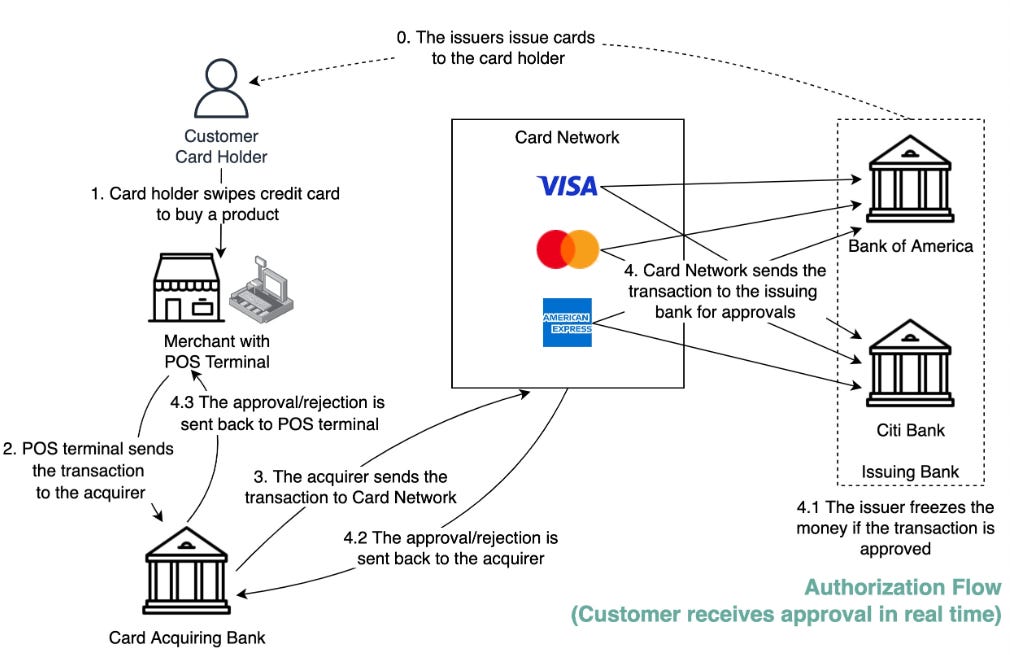
You tap your card, and the merchant’s point-of-sale (POS) terminal captures the transaction details and sends them to the merchant’s acquirer - or, in some cases, to a payment facilitator operating between the merchant and the acquirer, which we will discuss later.
The acquirer then routes an authorization request through the payment network, which forwards it to your issuing bank. The issuer verifies that you have sufficient available credit, runs the transaction through its fraud-detection models, and sends an approval back through the same chain.
All of this happens in well under 2 seconds.
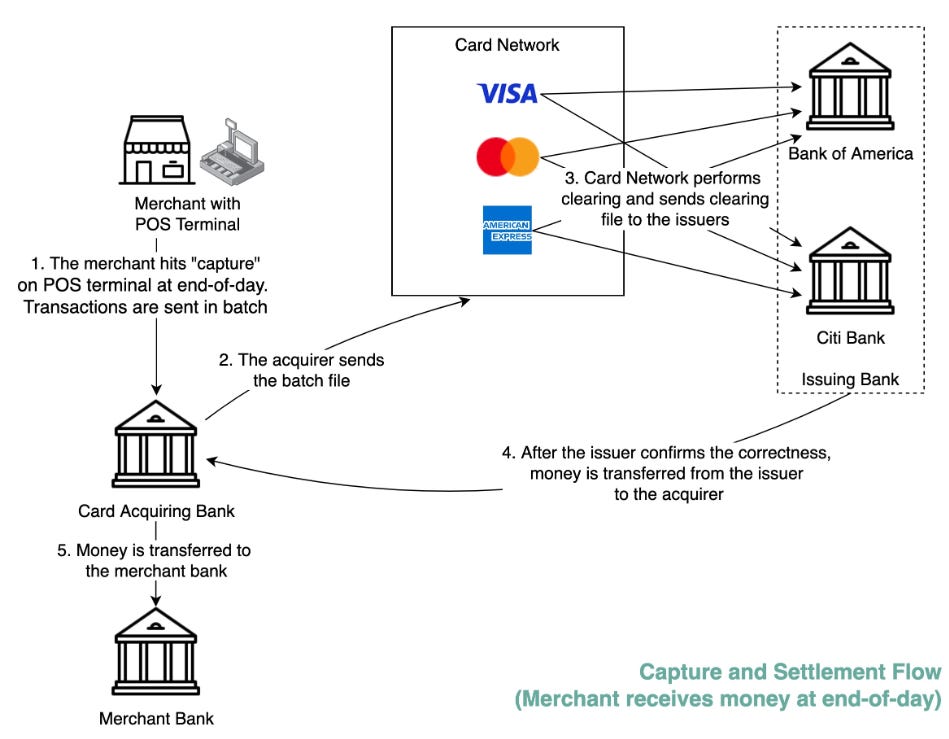
The financial movement occurs later, during clearing and settlement. At that stage, funds move from the issuing bank, through the network’s settlement infrastructure, to the acquirer and, ultimately, to the merchant.
Funds flow:
On a $40 credit card purchase, as most of you probably already know, the merchant doesn’t actually receive the full $40. Instead, it pays what is known as the Merchant Discount Rate, or MDR - the total cost of accepting the card.
For a typical credit card transaction, that cost might range from 2-3% of the purchase value.
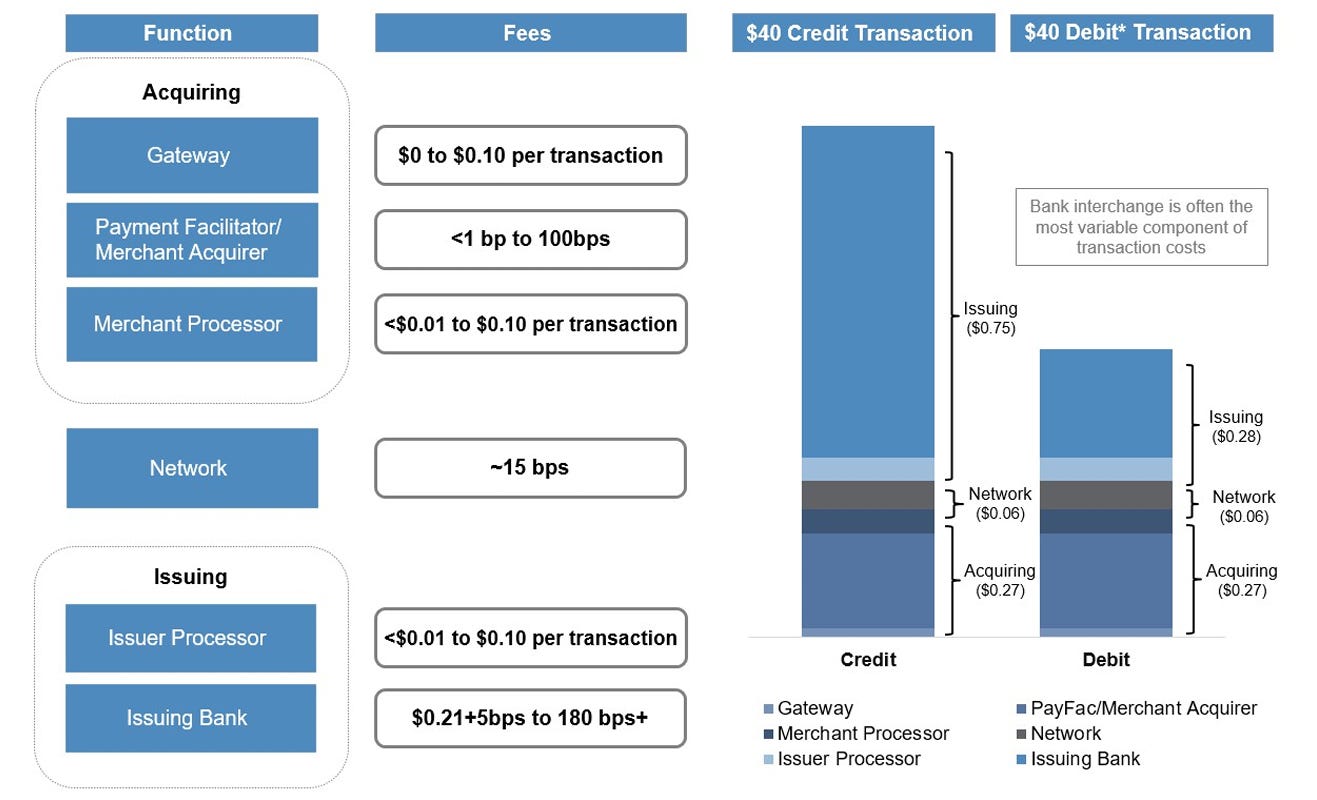
Assume an all-in MDR of ~2.5%, or about $1 on our $40 pair of headphones. That dollar is then divided among the different participants in the payment chain:
Interchange: by far the largest component of the merchant discount rate. It is paid by the acquirer, through the card network, to the bank that issued the customer’s card.
In our $40 transaction, interchange might amount to about $0.78, or close to ~2% of the purchase value.
Crucially, this isn’t Mastercard’s revenue. Interchange belongs to the issuing bank and helps fund credit card rewards such as cash back, airline miles, and loyalty points. It also explains why premium rewards cards typically carry higher acceptance costs for merchants.
Acquirer spread: the portion retained by the acquirer, payment facilitator, and merchant processor for connecting the merchant to the payment network, routing the transaction, managing settlement, and providing the infrastructure and services required to accept card payments.
In our simplified example, this portion might represent $0.16 of the total fee, although the exact amount depends on the merchant’s size, transaction volume, industry, and relationship with its payment provider.
Network fee: the smallest component of the merchant discount rate - and the portion that actually belongs to Mastercard. These fees are charged across both sides of the network for authorizing, clearing, and settling the transaction, as well as for providing access to Mastercard’s global payment infrastructure.
In the United States, Mastercard might collect approximately 10-18bps of the transaction value. On a $40 purchase, that would translate into $0.06 cents of revenue.
This is the paradox that makes card networks so widely misunderstood…
Mastercard is often blamed by merchants for the full cost of “swipe fees,” even though the vast majority of what they pay is interchange - revenue that flows to issuing banks, not to Mastercard. The network’s actual take rate is remarkably small.
And that is precisely what makes the model so difficult to disrupt.
Mastercard’s fee represents such a small portion of the merchant’s overall cost structure that switching to another payment rail would generate limited savings. Few merchants would abandon a network to save $0.06 on a $40 transaction - especially when that network provides near-universal acceptance, guarantees settlement, establishes fraud and liability rules, and connects them to billions of consumers around the world.
Mastercard captures only a tiny fraction of each transaction, but the value it provides is disproportionately large relative to the fee it charges.
Interchange vs. Network Fees:
When politicians criticize “swipe fees”, or when supporters of the Credit Card Competition Act (CCCA) claim that the average American family pays more than $1,200/year because of them, they are referring primarily to interchange fees - the portion of the transaction that card networks establish but don’t retain.
According to the Durbin-Marshall camp, banks collect more than $111B annually in swipe fees. But that is fundamentally a banking revenue pool, not a Mastercard revenue pool.
Mastercard and Visa act as the system’s price setters by establishing interchange schedules, yet the underlying economics accrue to the thousands of banks that issue cards on their networks. The networks themselves generate revenue primarily through (i) assessment fees, a small percentage of payment volume; and (ii) switching fees, which are charged for authorizing, clearing, and settling individual transactions.
On top of that sits a growing and increasingly important portfolio of Value-Added Services (VAS), which we will explore in much greater detail later.
When governments cap interchange - as the Durbin Amendment did for debit cards issued by large US banks in 2011 - the direct economic impact falls on the issuing banks. Mastercard and Visa are affected only indirectly, primarily through any resulting changes in transaction volumes, routing behavior, incentives, and the network fees earned on top of those transactions.
Acquirers vs. Card Networks:
Acquirers are not the same as card networks.
Although they operate within the same payment-processing chain, they perform fundamentally different roles and operate under radically different economic models.
The acquiring side (the sales and distribution arm that signs up merchants) and the processing side (the back-end plumbing that connects to the networks) have been consolidating and reshaping for years.
Today, the 10 largest US merchant acquirers account for almost 70% of Mastercard and Visa purchase volume, led by Fiserv ($FI), J.P. Morgan Payments, and Global Payments ($GPN).
Unlike the card networks, this is a scale-driven business with genuine competition, meaningful pricing pressure, and a major shift in bargaining power underway as software companies increasingly embed payments directly into their products.
The rise of payment facilitators, or “payfacs,” such as Square, Stripe, and Adyen has been one of the most important structural developments in the payments industry over the past 15 years. By sitting between merchants and traditional acquirers, these platforms control the customer relationship and capture a much larger share of the acquiring economics.
All of this competition and margin pressure takes place downstream of the network.
Whether a merchant is served by Fiserv, Stripe, Toast, or another provider, the transaction still typically runs across Mastercard’s rails - and Mastercard still collects its 10-18bps.
The intense competition among acquirers and processors, the payfac land grab, and the rise of software-led payments all reshape how economics are divided below the network layer. But none of them fundamentally displaces the network toll booth.
If anything, the proliferation of new acceptance channels increases the number of transactions flowing across Mastercard’s infrastructure.
That’s why I think of Mastercard less as a traditional payments company and more as a “royalty” on global commerce.
Payment Network Economics:
Card networks charge issuers and acquirers across two primary dimensions, supplemented by two additional revenue streams:
The first is an assessment or licensing fee calculated as a small % of the transaction’s notional value, a volume-based fee.
The second is a switching fee charged for each transaction authorized, cleared, or settled across the network, a transaction-based fee.
On top of these core revenue streams, Mastercard earns additional fees from cross-border transactions, which carry significantly higher yields because they involve international routing, greater complexity, and, in many cases, currency conversion (card networks love cross-border transactions).
The company also generates a growing share of its revenue from a broad portfolio of value-added services, including fraud prevention, cybersecurity, data analytics, consulting, loyalty, and identity solutions.
Taken together, these revenue streams form an exceptional business model built around 4 defining characteristics:
First, Mastercard operates as a toll on payment volume. Its revenue grows alongside nominal consumer spending, inflation, and the secular shift from cash to electronic payments - all at the same time.
Second, the model is capital-light to an almost absurd degree. The network has already been built, so the marginal cost of processing an additional transaction is close to zero. As a result, incremental operating margins can reach the mid-60% range.
Third, Mastercard benefits from powerful two-sided network effects. More cardholders make the network more valuable to merchants, while broader merchant acceptance makes it more valuable to cardholders.
This flywheel has been compounding for more than 60 years and has become extraordinarily difficult to replicate.
Fourth, the business generates recurring, diversified, and highly visible revenue across billions of transactions, hundreds of markets, and thousands of issuing and acquiring relationships. No single customer, merchant, bank, or geography is large enough to meaningfully impair the overall network.
Rebates and Incentives:
Mastercard and Visa pay substantial sums back to issuers, merchants, and acquirers through volume-based incentives designed to win new business and retain existing relationships. These payments are recorded as contra-revenue.
In 2025, Mastercard’s gross rebates and incentives totaled $20.5B - more than Visa’s $16.2B - even though Mastercard processed approximately 40% less volume.
That gap reveals an important difference in how the two networks compete, which we will revisit in the Visa comparison. Mastercard tends to use incentives as an effective volume discount against a higher gross price, while Visa appears more willing to adjust headline pricing directly.
The key takeaway is that net revenue yield - after rebates and incentives - is what ultimately matters. And despite the intensity of competition, both networks have managed to expand their net yields over time, supported by the growing contribution of value-added services and higher-yielding cross-border transactions.

Found this content valuable? Leave a restack and like this article. These small actions go a long way in helping more people discover our work.
2. Business History:
Mastercard traces its origins to 1966, when a consortium of regional banks met in Buffalo, New York, to form the Interbank Card Association. Their goal was to create a competing network to Bank of America’s rapidly expanding card program, which would eventually become Visa.
The founding members included institutions such as United California Bank, Wells Fargo, Crocker National Bank, and the Bank of California. The association’s first major product was branded “Master Charge”. In 1969, it introduced the now-iconic interlocking red-and-yellow circles - a fitting visual metaphor for an interoperable payment network - and the company adopted the Mastercard name in 1979.
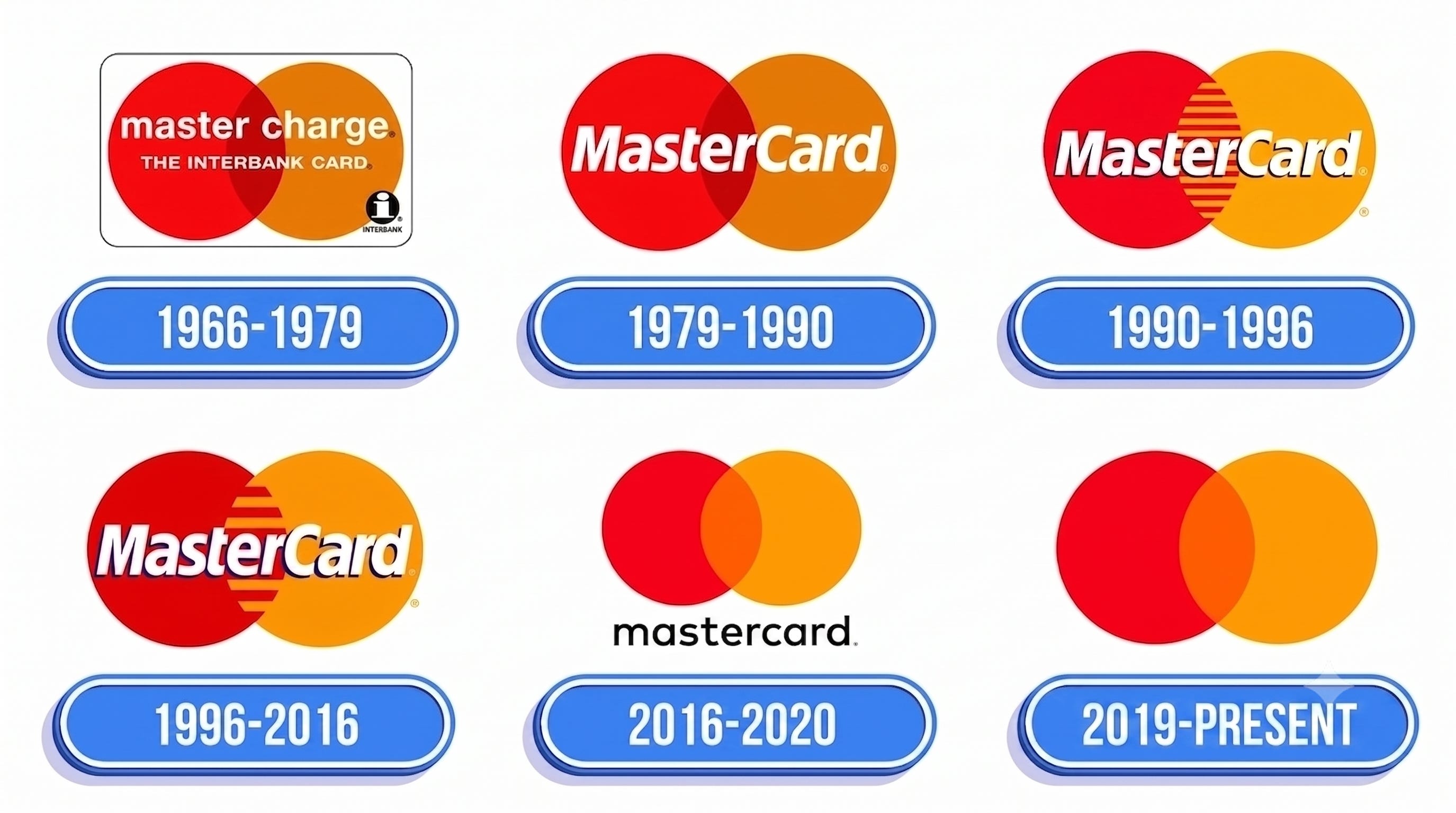
For its first 35 years, Mastercard operated as a bank-owned cooperative. Member banks paid to participate, held ownership interests linked to their involvement, and collectively governed the association as a shared utility. The primary objective wasn’t to maximize Mastercard’s corporate profits, but to expand card issuance, merchant acceptance, and the overall reach of the network.
That structure worked well in the company’s early years, when the interests of participating banks were broadly aligned. But as the network expanded, the member base grew more complex and those interests increasingly diverged. Internal conflicts, governance limitations, and mounting antitrust scrutiny eventually made the cooperative model difficult to sustain.
In 2002, Mastercard reorganized as a private share corporation, laying the groundwork for the defining event in its corporate history.
In May 2006, the company completed its IPO on the NYSE under the ticker $MA. Shares were priced at $39, and the offering raised approximately $2.4B.
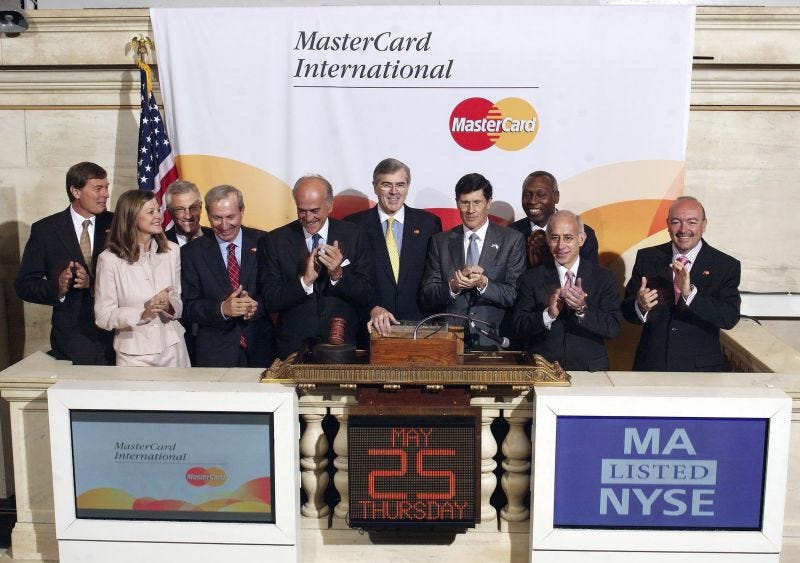
The transaction accomplished two important things:
First, it transferred ownership from Mastercard’s member banks to public shareholders.
More importantly, it created a clearer layer of legal and governance separation between the network and the banks that issued cards on its rails, helping distance the company from the antitrust liabilities that had accumulated under the cooperative structure.
Since going public, Mastercard has pursued a deliberate and patient transformation from a pure card-switching network into a diversified payments and services technology company.
In 2010, Mastercard acquired DataCash to strengthen its e-commerce gateway capabilities. In 2017, it purchased VocaLink for $920M, adding real-time account-to-account payments and automated clearing house infrastructure - a decisive move beyond traditional card rails.
That same year, it acquired NuData for behavioral biometrics. This was followed by Transfast in 2019, which expanded Mastercard’s cross-border remittance capabilities; RiskRecon in 2020 and Recorded Future in 2024 for approximately $2.65B, strengthening its cybersecurity offering; and Finicity in 2020, which gave the company a stronger position in open banking.
Each transaction followed the same strategic logic: build capabilities that sit alongside the core network, deepen the value Mastercard delivers to issuers, merchants, governments, and consumers, and diversify revenue beyond traditional card-based transaction processing.
Mastercard was no longer content to simply move payments from one endpoint to another - and increasingly wanted to secure them, analyze them, authenticate them, and provide the software and data infrastructure surrounding them.
Enjoying the content? Upgrade to Jimmy’s Journal Pro to unlock the full experience.
3. Business Model:
Revenue Lines:
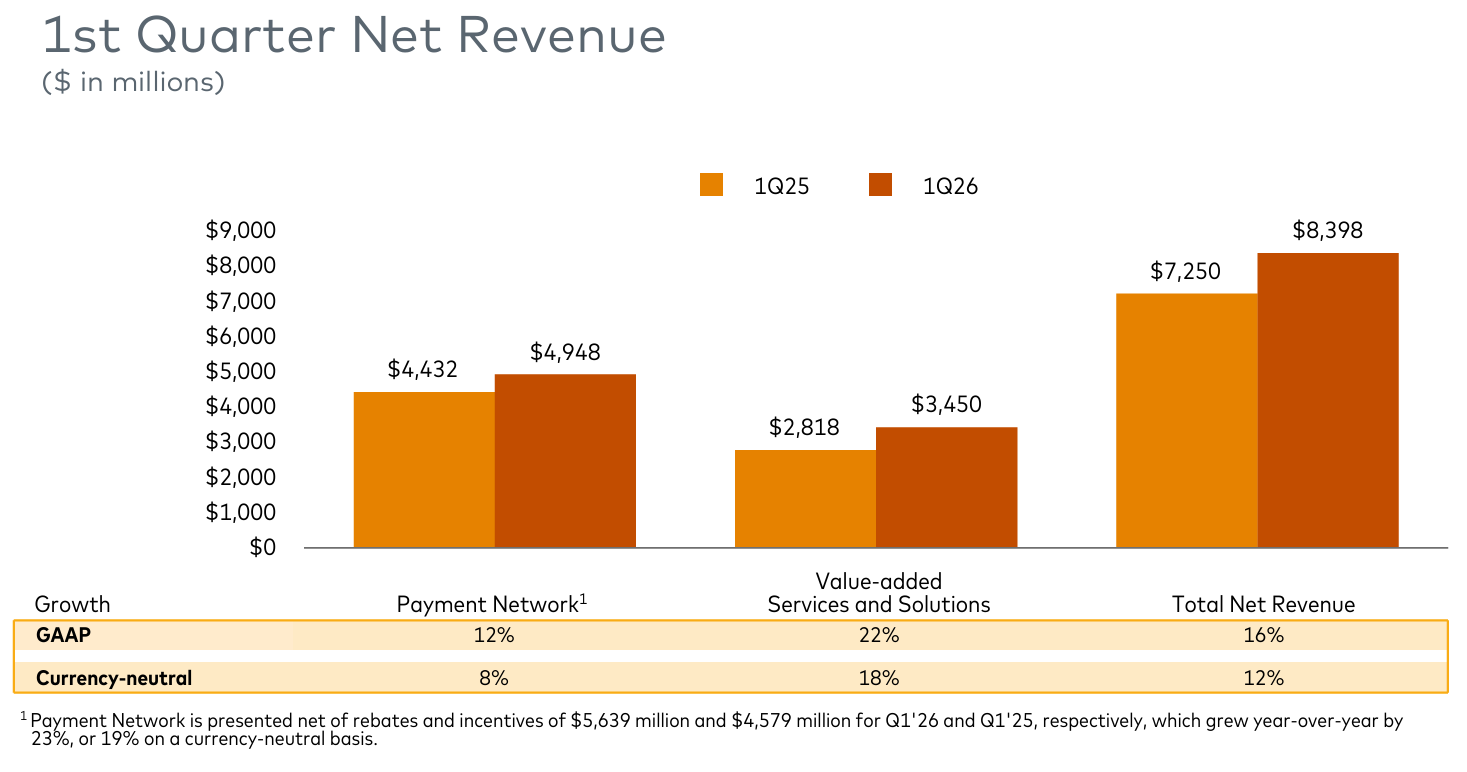
Mastercard reports its revenue across two broad categories:
Payment Network Revenue (59% of total): the traditional toll-booth business at the core of the company’s model. This revenue stream can be broken down into four main components:
Domestic assessments are volume-based fees tied to transactions that take place within a country.
Transaction processing fees are charged each time Mastercard authorizes, clears, or settles a transaction across its network.
Cross-border volume fees are the much higher-yield charges earned when a transaction crosses a national or currency boundary.
The remaining revenue falls into a smaller “other” category.
Value-Added Services and Solutions (41% of total): this is the fastest-growing - and arguably the most strategically important - part of Mastercard’s business, which is why we’ll devote an entire section to it later.
For now, it is enough to understand that VAS&S includes cybersecurity and fraud-prevention tools, data analytics and consulting, loyalty and marketing services, open-banking solutions, and payment-processing and gateway capabilities.
The first bucket monetizes the movement of money. The second monetizes the data, security, intelligence, and software surrounding that movement.
The rest of this report is exclusively for Pro members.
Below the fold, we break down Mastercard’s three-sided value proposition, its duopoly with Visa, the real impact of the CCCA and other regulatory risks, the threat and opportunity presented by stablecoins and agentic commerce, the growth of Value-Added Services, and our complete valuation - including the DCF, sensitivity analysis, and target price.
Join Jimmy’s Journal Pro for $397/year ($33/month) to unlock the full report, along with our complete library of valuation models and deep dives.